





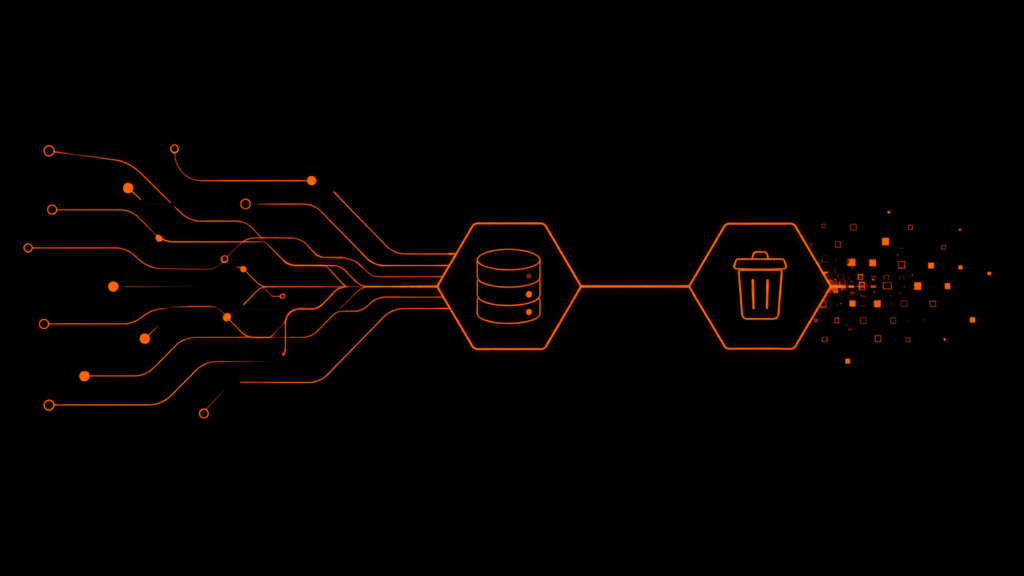
Data Must Not Only Be Used — It Must Be Forgotten
(Understanding Palantir, #7)
In the evolution of data-driven organizations, most attention has been placed on how data is collected, integrated, and used.
Far less attention has been given to an equally critical question:
When — and how — should data cease to exist?
As concerns around privacy, regulation, and institutional accountability grow, deletion has moved from a technical afterthought to a core design principle.
At Palantir Technologies, deletion is not treated as a one-time operation.
It is understood as a continuous, system-level process — one that must be designed with the same rigor as data ingestion, governance, and decision-making.
The Misconception: Deletion as an Event
Most organizations approach deletion as a binary action:
Data exists → Data is deleted.
In practice, this is almost never true.
Deletion is not an event.
It is a process unfolding over time.
Access is first removed.
Dependencies are identified.
Impacts are assessed.
Data is progressively erased across systems.
And even then, complexity remains.
Because in modern architectures, data does not live in one place.
It exists across:
- Source systems
- Derived datasets
- Analytical models
- Operational workflows
Deleting data in one layer without addressing the rest does not eliminate it.
It simply obscures it.
The Real Challenge: Distributed Data
As organizations scale, data becomes deeply interconnected.
A single record may:
- Appear in multiple systems
- Be transformed into aggregated datasets
- Feed predictive models
- Influence operational decisions
This creates a fundamental challenge:
How do you ensure that deletion propagates across the entire system?
Failure to do so introduces both regulatory risk and operational inconsistency.
Data thought to be deleted may still exist downstream.
Models may continue to rely on outdated or invalid inputs.
Systems may act on information that should no longer exist.
Deletion, therefore, is not just about removing data.
It is about maintaining system integrity.
Soft vs Hard Deletion
Understanding deletion requires distinguishing between two states:
- Soft deletion → data is no longer accessible, but still exists
- Hard deletion → data is irreversibly removed
In practice, most organizations operate within a spectrum between these two.
Immediate hard deletion is often not feasible due to:
- System dependencies
- Regulatory requirements
- Operational safeguards
Instead, deletion must be staged, reversible at certain points, and fully auditable.
What matters is not the method —
but the outcome:
Data that is meant to be deleted must no longer be usable.
Why Deletion Matters
Deletion is not only about compliance.
It is about limiting exposure and preserving trust.
Keeping data longer than necessary creates risk:
- Legal liability
- Security vulnerabilities
- Reputational damage
In some cases, the mere presence of data within a system can have material consequences for individuals.
Deletion, therefore, becomes a mechanism of:
- Data minimization
- Risk reduction
- Ethical responsibility
From Policy to Execution
Most organizations define deletion policies.
Few successfully operationalize them.
The gap lies in execution.
Policies answer what should happen.
Systems must ensure that it actually happens.
This requires:
- Clear ownership of deletion processes
- Defined triggers (time-based, request-based, regulatory)
- Visibility into affected data
- Coordination across systems
- Verification that deletion has been completed
Without these, deletion remains theoretical.
Embedding Deletion Into the System
Within platforms like Palantir Foundry, deletion is integrated directly into the data lifecycle.
This allows organizations to move from manual, fragmented processes
to coordinated, system-level deletion workflows.
Key elements include:
End-to-End Data Visibility
Understanding what data exists, where it resides, and how it is connected is a prerequisite for deletion.
Without visibility, deletion cannot be complete.
Lineage-Aware Deletion
Deletion is propagated through the system based on data lineage:
- Upstream sources
- Downstream datasets
- Derived outputs
This ensures consistency across all layers.
Controlled Execution
Deletion processes can combine:
- Automation (for consistency and scale)
- Human validation (for oversight and exception handling)
Striking the right balance between both is critical.
Continuous Monitoring
Even after deletion, systems must verify:
- That data has not re-entered
- That no residual dependencies remain
- That processes continue to comply
Deletion is not the end of the process.
It is part of an ongoing cycle.
The Hardest Problem: Selective Deletion
One of the most complex challenges is not deleting entire datasets —
but deleting parts of them.
For example:
- A single user requests deletion
- Regulatory requirements apply only to specific attributes
- Certain data must be retained for legal reasons
This creates tension between:
- Data integrity
- Legal compliance
- Operational continuity
Resolving this requires precise control over:
- Data structures
- Relationships
- Dependencies
And reinforces the importance of having a well-defined ontology.
Why This Matters
As organizations become more data-driven, they accumulate not only value —
but responsibility.
Data is not neutral.
It carries implications for individuals, institutions, and society.
The ability to remove data reliably is as important as the ability to use it.
Because:
- Systems that cannot forget become liabilities
- Organizations that cannot delete lose control
- Institutions that cannot enforce limits lose trust
A System That Knows When to Forget
If previous articles established how organizations:
- Structure data (Ontology)
- Trust data (Transparency and Lineage)
- Act on data (Operational AI)
Then deletion completes the picture.
It defines the boundaries of the system.
Not everything should persist.
Not everything should be accessible forever.
A Simple Way to Understand It
If data is the signal,
and AI enables action,
deletion ensures that the system does not act on what should no longer exist.
Or, extending the analogy:
If Palantir Technologies is the nervous system,
and ontology defines the body,
and trust ensures signal integrity,
and AI enables response,
then deletion is what allows the system to forget — deliberately, correctly, and safely.
The Final Idea
A complete data system does not only know how to:
- Ingest
- Understand
- Decide
- Act
It also knows when to stop.
And when to forget.